



 MENU
MENU Optical Quality Control
 Robotic Systems
 Industrial software development

Introduction
A Czech manufacturer of transport solutions for the automotive industry needed to automate repetitive thread cutting in steel components. Each part contains several dozen laser-cut through holes that require M8 threads. With production running into thousands of parts, this represented a substantial volume of repetitive and ergonomically demanding manual work.
For this application, KINALI integrated an AUBO i20 collaborative robot with a ToolDrives tapping module. The robot moves and positions the tool between individual holes, while ToolDrives performs the machining operation itself. KINALI also supplied the control script, base threading program and communication integration between the two technologies.
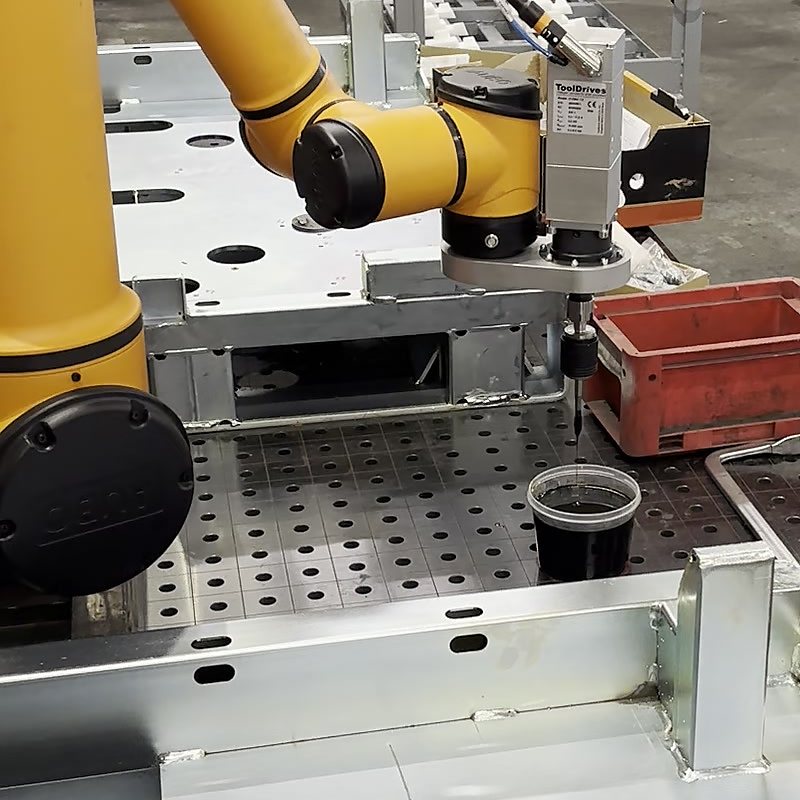
Showcase of automated thread cutting for an automotive packaging manufacturer using the AUBO i20
Project Requirements
Before automation, the operator cut the threads manually using a cordless tool fitted with a tap. Approximately 44 threads had to be produced on each part. Across thousands of manufactured units, the process therefore represented a significant amount of repetitive manual work.
The customer's objective was to speed up the operation and reduce the amount of operator capacity required for a process that can be precisely defined and repeated. The new solution needed to process all defined working positions, coordinate robot movement with tap rotation and allow the operator to prepare another part while the robot was running.
bot and ToolDrives robotic machining tools.
Do you have a similar need as Delong Instruments?
Get in touch. We'll be happy to design a customized solution for you.
Do you have a similar need as Delong Instruments?
Get in touch. We'll be happy to design a customized solution for you.
When designing the solution, we considered whether to use the AUBO i10 (with a load capacity of 10 kg) or the i5 (with a load capacity of 5 kg). In the end, we chose the i5 option as its range and weight is sufficient for most of the operations considered by the client and it is cheaper compared to the i10.
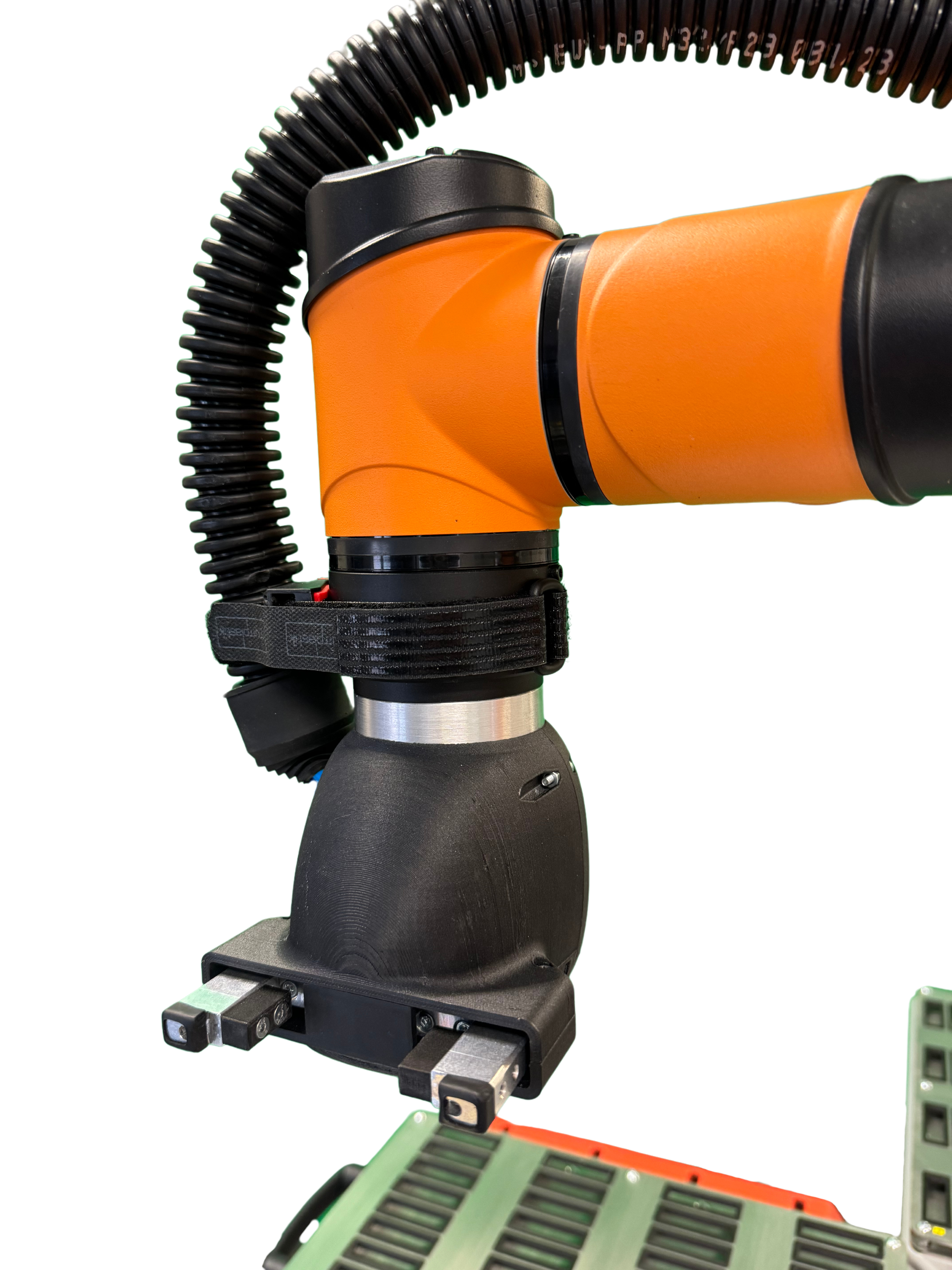
The blower used to clean the parts, located on the robot's end effector, is custom-made in KINALI's capabilities (using our own 3D printers).
Thanks to the use of three staging tables, the part can be machined unattended from both sides while the workpiece can be replenished on the fly at the input. This creates a continuous operation.
We were considering a dual gripper that could handle two parts at once for the job. However, this is an additional investment. As the client did not require high speed machine operation and a dual gripper would have unnecessarily increased costs, we dropped this option.
Project Requirements
Before automation, the operator cut the threads manually using a cordless tool fitted with a tap. Approximately 44 threads had to be produced on each part. Across thousands of manufactured units, the process therefore represented a significant amount of repetitive manual work.
The customer's objective was to speed up the operation and reduce the amount of operator capacity required for a process that can be precisely defined and repeated. The new solution needed to process all defined working positions, coordinate robot movement with tap rotation and allow the operator to prepare another part while the robot was running.
KINALI Solution
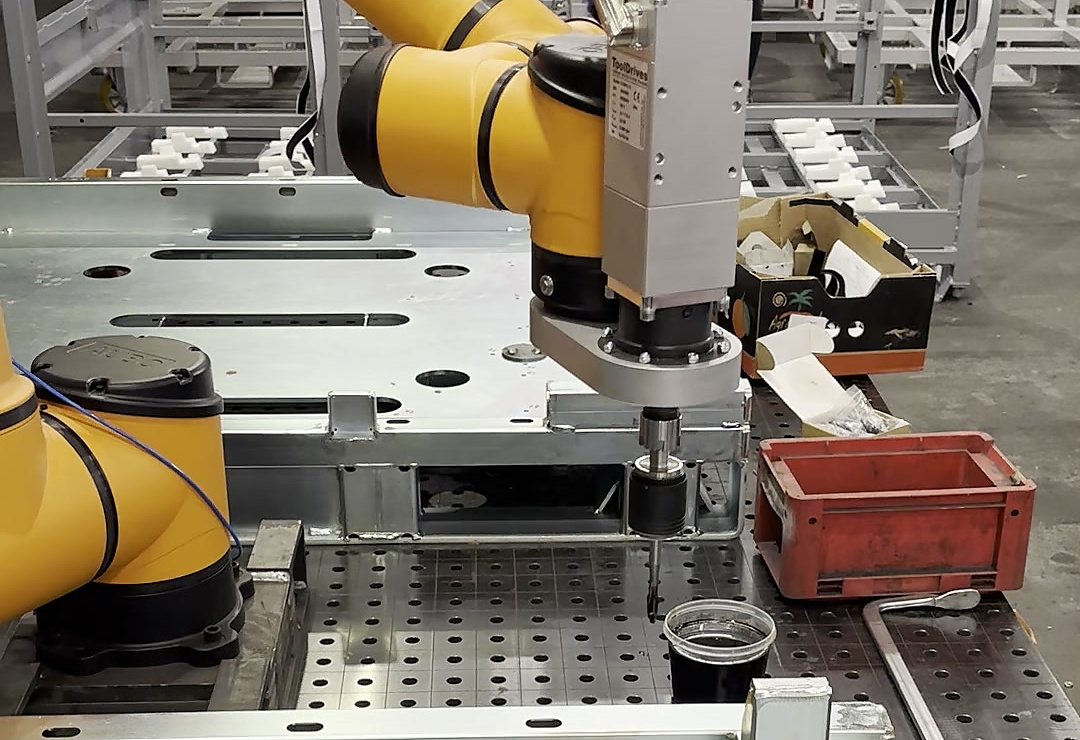
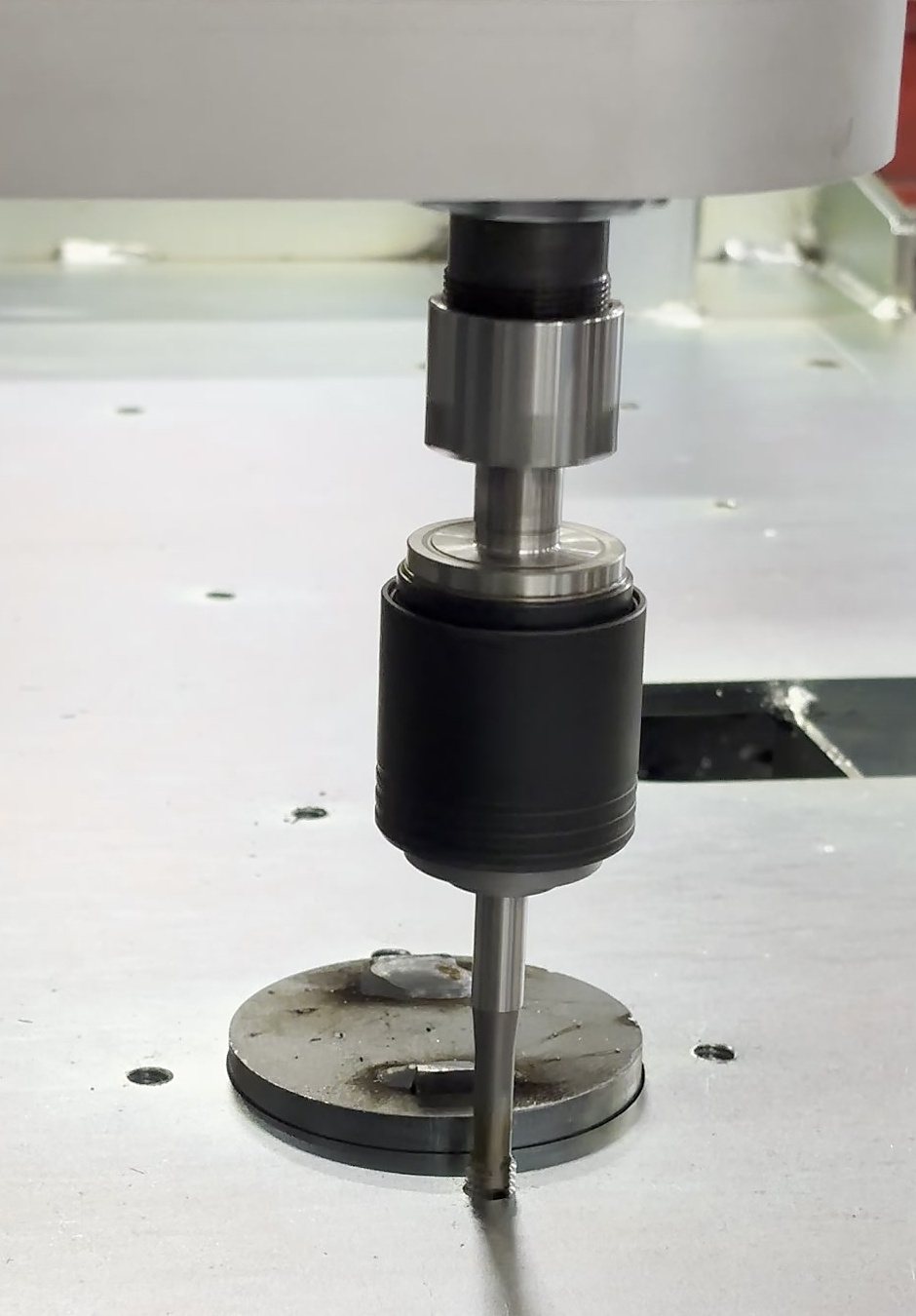
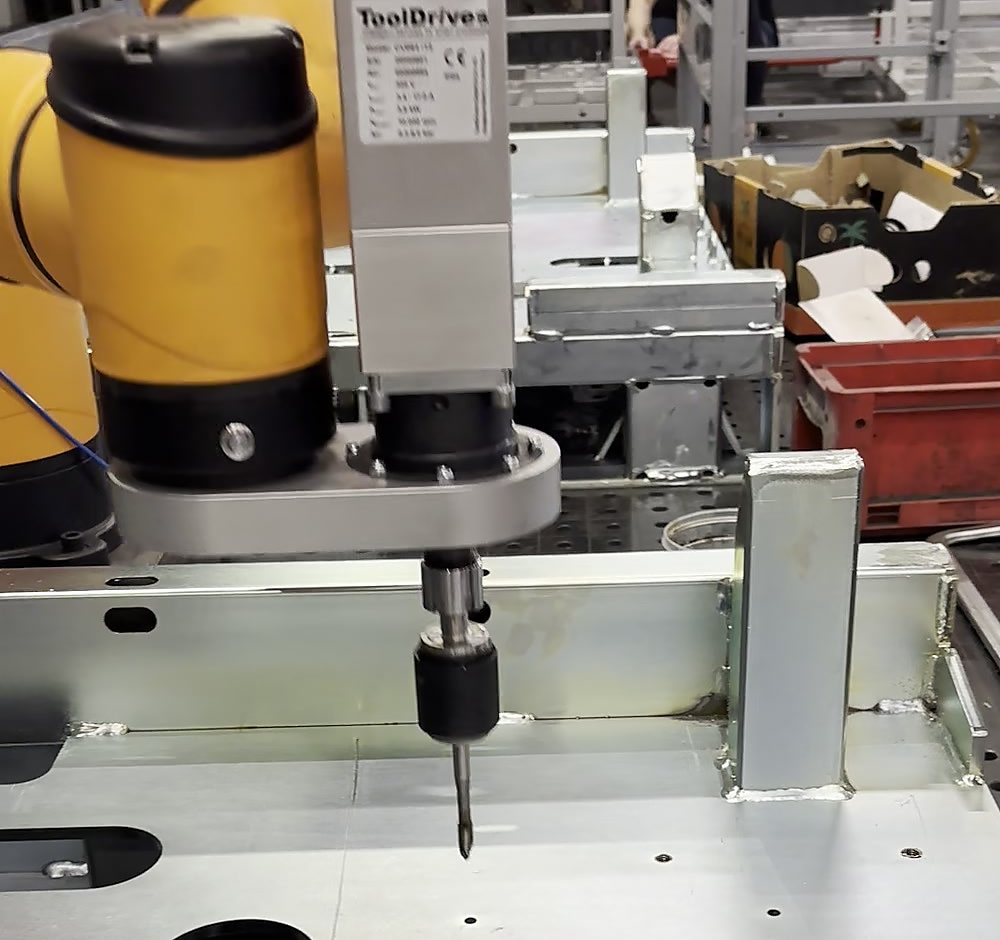
The application is based on an AUBO i20 collaborative robot with a ToolDrives tapping module and M8 tap mounted directly on its end effector. The robot guides the active machining tool between predefined positions and aligns it with the axis of each hole. ToolDrives powers the tap and performs the actual thread-cutting operation in a through hole with an approximate thread length of 5 mm.
The customer purchased the ToolDrives technology separately. KINALI supplied the AUBO i20, developed the script used to control the tapping module, created the base program for the individual working positions and commissioned communication with the ToolDrives controller. The KINALI scope therefore consisted of the robot, programming and system integration of the tapping application, rather than delivery of a complete production line.
The machining-tool speed is configured in the ToolDrives controller. The same value is entered into the AUBO program, which calculates the corresponding robot feed rate according to the thread dimensions and spindle speed. Start and direction of rotation, status signals and selected safety functions are exchanged between the robot and the tapping unit through digital inputs and outputs.
How the Workstation Operates
The operator places the steel component on the worktable. Locating elements engage with prepared holes and define the position of the part. During programming, every hole intended for threading was individually taught so that the robot could guide the tool along a defined path.
After the cycle starts, the AUBO i20 moves to the first laser-cut through hole and aligns the tap with its axis. The robot starts the ToolDrives module through digital signals and then synchronises the robot feed rate with the configured spindle speed. Once one thread is complete, the robot moves to the next hole and repeats the operation.
The tapping unit allows a limited amount of axial tool movement, helping to compensate for small deviations while the tap enters the hole. After a predefined number of operations, the robot moves the tap into an oil container. Tool lubrication is therefore integrated directly into the robot program.
The workstation uses two working positions. While the robot threads a component at one position, the operator can remove a completed part and prepare the next one at the opposite position. Once the cycle has finished, the robot returns to its home position and waits for the operator to confirm that the next part is ready.
Main Components
| Component | Function in the Application |
|---|---|
| AUBO i20 collaborative robot | Moves and positions the tapping tool between individual working locations. |
| ToolDrives tapping module | Drives the active machining tool during automated thread cutting. |
| M8 tap | Creates M8 threads in the laser-cut through holes. |
| ToolDrives controller | Controls spindle speed and provides status and safety signals. |
| KINALI robot script | Calculates the working feed rate, manages digital communication and coordinates the tapping cycle. |
| Locating workstation | Positions and centres the part using locating elements inserted into prepared holes. |
| Lubrication point | Allows the tap to be regularly dipped into oil after a predefined number of operations. |
ToolDrives Technology in a Robotic Application
In this application, the collaborative robot does not carry a passive gripper, but an active machining tool. The AUBO i20 provides flexible movement and accurate guidance between working positions, while ToolDrives rotates the tap and performs the machining operation. KINALI integrated both technologies into one coordinated cycle.
This division of tasks is particularly useful when repeatedly machining multiple positions on a large component. Instead of handling the complete workpiece, the robot moves the lighter machining tool between individual locations. Following technical assessment, the same principle can also be relevant to other suitable robotic machining and finishing operations, depending on the material, process forces, required accuracy and overall safety requirements.
Integration and Commissioning
KINALI's main role in the project was integration and programming. After the tapping module was mounted on the robot flange, the team commissioned digital communication with the ToolDrives controller, developed a script coordinating spindle speed and robot feed, and taught the individual working positions.
Commissioning required the robot feed rate to be matched with the spindle speed and the geometry of the M8 thread. Regular lubrication was also incorporated into the robot program. One of the practical challenges was accurately teaching several dozen hole positions while maintaining enough tolerance for reliable tap entry into each through hole.
Safety and Operation
The robot receives status and safety signals from the tapping module. If the tool is not rotating or the unit reports an error condition, the robot does not begin its working movement. The robot's collision protection is also active.
The operator loads and unloads the component, confirms continuation of the program, visually checks tap wear and replaces the tap manually when necessary. The workstation does not automatically inspect the quality of the finished thread. The working depth is fixed in the program.
The use of a collaborative robot alone does not determine the safety of the complete application. The final safety concept must consider robot movement, the rotating tool, the machined material, the loading method and the physical layout of the workstation.
Results
The AUBO i20 automated the repetitive production of several dozen threads on every component. The operator no longer needs to perform the complete sequence manually and can prepare another part at the second working position while the robot is operating.
According to customer feedback, the combination of the collaborative robot and tapping unit operated for several weeks without operational problems. During that period, the workstation produced thousands of threads without a recorded broken tap or incomplete thread. The customer also assessed the economic benefit and return on investment positively. This represents the customer's operational experience rather than an independently verified financial calculation.
Interesting Details from the Project
Two Working Positions Used in Parallel - The two-position workstation reduces waiting time between cycles. While the robot processes one part, the operator can remove a finished component and prepare another one on the opposite side. Part changeover therefore takes place in parallel with the robotic operation.
Automated Tool Lubrication - Tap lubrication is part of the robot program. After a predefined number of threads, the AUBO robot moves the tool into an oil container before continuing the cycle. This reduces the need to interrupt the program manually for regular lubrication.
The Collaborative Robot as a Carrier of an Active Tool - The project demonstrates a use of collaborative robotics beyond conventional material handling. Instead of moving the product, the robot precisely guides the machining module between individual holes. ToolDrives performs the tapping operation while the KINALI control logic coordinates both systems.
Přesvědčte se v našem showroomu, co již dnes robotické systémy umí.
Přesvědčte se v našem showroomu, co již dnes robotické systémy umí.
Experience Gained
The project expanded KINALI's experience with integrating active machining technology with collaborative robots. A key part of the implementation was coordinating robot movement with the tapping-module speed, calculating the correct working feed rate and accurately teaching a large number of working positions.
The project also demonstrated the practical value of limited axial tool movement for compensating for small deviations during tap entry, as well as integrating regular lubrication directly into the robot program. The resulting application confirms that, with the correct technical setup, collaborative robots can also be used for selected active machining operations.
Conclusion
Automated thread cutting replaced a repetitive manual operation in the production of steel transport solutions for automotive components. The AUBO i20 guides the tool between individual holes, ToolDrives performs the tapping operation and the KINALI integration script coordinates their operation.
The project is an example of targeted automation of a specific manufacturing step without the need to supply an entirely new production line. Its main benefits are the automation of repetitive work, the use of two parallel working positions and the extension of the collaborative robot's role from material handling to active machining.
Learn more about KINALI robotic systems, automated machine operation, the AUBO i20 collaborative robot and ToolDrives robotic machining tools.
“The collaborative robot with the tapping unit has been operating for several weeks without any operational issues. During this time, it has produced thousands of threads without a broken tap or a single incomplete thread. We are very positive about the economic benefits of the solution.”
Customer representative
Project Gallery


